Greenwich Development Finance 2026: North Greenwich Peninsula, Woolwich Crossrail Regen & The Maritime Premium
Greenwich is down 2.2% year on year in February 2026, against a Greater London headline of -3.3%. That puts the borough 110 basis points above the regional benchmark — mid-band, ahead of every adjacent inner river borough including its sister regen borough Southwark at -2.8% and Tower Hamlets across the river at -3.8%. The Royal Borough sits between the inner river belt and the outer south-east ring, and the borough number reflects exactly that hybrid position.
The story underneath the number is four sub-zone economies layered into one administrative footprint. Maritime Greenwich is the UNESCO World Heritage premium anchor — the Old Royal Naval College, the Cutty Sark, the Royal Observatory, the Greenwich town centre townhouse stock. Heritage protection is the supply constraint, and supply constraint is the price floor. North Greenwich on the peninsula is the structural BTR and PBSA pipeline — the O2 Arena, the Greenwich Peninsula masterplan, the IKEA cluster, roughly ten thousand homes consented across the wider peninsula. Woolwich is the Crossrail catalyst — the Elizabeth Line terminus opened in 2022 has materially repriced the Royal Arsenal corridor through 2024 and 2025. Eltham and Blackheath are the family-resi structural backstop on the south of the borough. Four sub-zone economies. One borough number.
Why Greenwich is the south-east river anchor in 2026
Most south London boroughs have one regen story working at any given time. Greenwich has a heritage premium, a peninsula pipeline, a Crossrail catalyst and a family-resi backstop running concurrently, and that breadth is the structural fact that explains the borough number sitting 110 basis points above the regional benchmark.
Maritime Greenwich is the UNESCO World Heritage core. The Old Royal Naval College, the Queen’s House, the Royal Observatory, the National Maritime Museum, the Cutty Sark, the Greenwich town centre Georgian and Victorian townhouse stock. Heritage protection means the supply pipeline here is largely value-add reposition rather than new-build. That is exactly the structural condition that supports premium values through a softer market cycle.
The North Greenwich peninsula is the largest single-developer mixed-use footprint in inner south-east London. The Greenwich Peninsula masterplan supports roughly ten thousand homes consented in phases over the long run, with the O2 Arena, the IKEA cluster, the Ravensbourne University campus and the wider peninsula office and amenity footprint all anchoring the long-term GDV. Phase delivery has been continuous through 2018 to 2026, with active forward-fund take-outs concentrated in the BTR and PBSA bands.
Woolwich is the borough’s Crossrail catalyst. The Elizabeth Line terminus opened in May 2022, and the journey-time compression to Canary Wharf and Tottenham Court Road has materially repriced the Royal Arsenal masterplan through 2023, 2024 and 2025. Berkeley Group’s Royal Arsenal scheme is one of the largest single-developer London schemes by GDV, with continued phase delivery through 2026 alongside adjacent Woolwich town centre regen.
Eltham, Blackheath, Charlton, Plumstead and Thamesmead are the structural backstop. Family resi at Eltham (more affordable than the inner west boroughs by a wide margin), premium suburban village at Blackheath, riverside mid-rise growth at Charlton, Crossrail-catchment infill at Plumstead, and peripheral Peabody / L&Q regen at Thamesmead. Together they widen the borough’s revenue mix and damp the headline volatility.
Reading the -2.2% in context
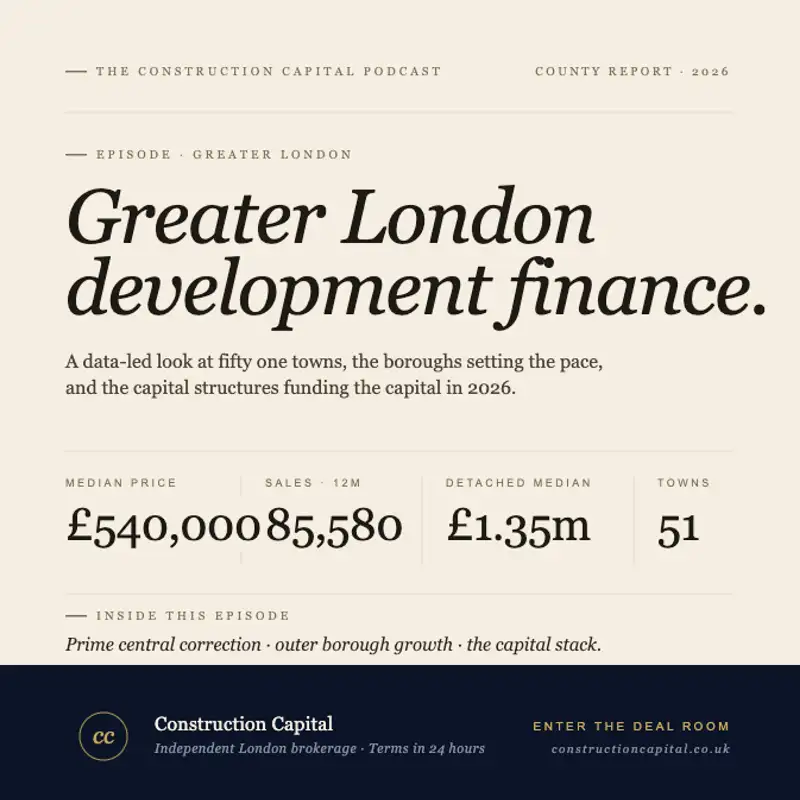
Greater London’s headline house-price index fell 3.3% year on year in February 2026 to a regional median of around £542,000 across roughly 85,580 transactions in the rolling twelve months. New-build completions ran at just 1.9% of total activity. Greenwich’s -2.2% is 110 basis points above the regional benchmark.
Sister south-east regen borough Southwark, immediately upriver, is at -2.8%. The Greenwich-Southwark spread is 60 basis points and is the cleanest regen-borough comparison on the south-east table. Southwark’s Canada Water structural-build pipeline drags the headline marginally below Greenwich because the active build phase sits inside the borough number; Greenwich’s North Greenwich peninsula has been delivering continuously for longer, with phases now in the absorption-cleared band.
Tower Hamlets across the river is at -3.8%, a full 160 basis points below Greenwich. The Canary Wharf and Isle of Dogs high-rise re-sale layer is the structural difference — Greenwich has nothing equivalent on its side of the river, and Greenwich’s own peninsula tower stock is in active build / forward-fund phase rather than the open-market re-sale phase that drags Tower Hamlets. Lambeth is at -3.5%. Bromley further south is at +3.0% — the connected outer suburban borough that sits structurally above the inner river belt.
Walthamstow, the inner-east outperformer, is up 5.9% over the same window. The Walthamstow-Greenwich spread is 8.1 percentage points and is a function of Walthamstow having no high-rise stock to give back and no large-scale regen completion bunching. At the other end, Kensington and Chelsea is down 11.2% and Westminster is down 10.8%. Greenwich sits mid-band, with the heritage premium core, the peninsula pipeline, the Crossrail-catalysed Woolwich corridor and the family-resi backstop all rolled into the same borough term sheet.
The sub-zone anatomy: Maritime Greenwich, North Greenwich peninsula, Charlton, Woolwich, Eltham, Blackheath, Plumstead, Thamesmead
Maritime Greenwich (SE10). UNESCO World Heritage core. Old Royal Naval College, Queen’s House, Royal Observatory, Cutty Sark, Greenwich Park. Greenwich town centre Georgian and Victorian townhouse stock. DLR via Cutty Sark and Greenwich, mainline rail to London Bridge and Cannon Street. The borough’s premium domestic anchor. Heritage protection is the supply constraint. Bridging-led value-add reposition at 0.55-0.70% per month is the dominant capital flow.
North Greenwich peninsula (SE10). The structural growth zone. Greenwich Peninsula masterplan, O2 Arena, IKEA, Ravensbourne University, peninsula tower cluster. Roughly ten thousand homes consented across the wider peninsula in phases. Jubilee Line at North Greenwich. The borough’s BTR forward-fund pipeline is concentrated here through 2025-2030. Forward-fund yields clearing 5.0-5.5% net on credible plots. PBSA forward funding active in the 5.25-5.75% band on the Ravensbourne / peninsula catchment.
Charlton (SE7). Riverside fringe between Greenwich and Woolwich. Charlton Riverside masterplan supports new mid-rise resi at scale. Charlton mainline rail. Mid-tier resi-led growth corridor. Senior debt from 6.5% at 65-70% LTGDV on credible mid-rise schemes.
Woolwich (SE18). The Crossrail catalyst. Elizabeth Line terminus station opened May 2022. Royal Arsenal masterplan (Berkeley Group, one of the largest single-developer schemes in London by GDV) continues phase delivery through 2026. Adjacent Woolwich town centre regen has materially repriced through 2024 and 2025. Senior debt from 6.5% at 65-70% LTGDV on Royal Arsenal phase work and adjacent town-centre mid-rise. Selected Royal Arsenal forward funds clearing 5.0-5.5% net.
Eltham (SE9). Family-resi south end. Eltham Palace, Eltham High Street, Eltham mainline rail. More affordable than the inner west boroughs by a wide margin. The borough’s structural family-resi backstop. Bridging-led value-add reposition on Edwardian / Victorian stock dominant.
Blackheath (SE3). Premium suburban village (shared with Lewisham). Blackheath village, Blackheath Common, Royal Heath. Family resi, premium Edwardian and Victorian stock. The borough’s premium suburban hold-up zone, correcting closer to flat than the borough headline implies. Bridging at 0.55-0.70% per month.
Plumstead (SE18). East of Woolwich. Plumstead mainline rail (one stop from the Woolwich Crossrail terminus). Crossrail-catchment infill mid-rise. Senior debt from 6.5% at 65-70% LTGDV on credible small-mid-rise schemes.
Thamesmead (SE2 / SE28, shared with Bexley). Peripheral. Peabody and L&Q regen ongoing. Mixed-tenure social-rented and mid-tier resi delivery. The DLR extension to Thamesmead has been mooted for a decade and remains a structural long-end question for the area.
Why the North Greenwich peninsula pipeline matters
The North Greenwich peninsula is the largest single-developer mixed-use footprint in inner south-east London by consented GDV. The Greenwich Peninsula masterplan supports roughly ten thousand homes in phases, plus the O2 Arena and the wider entertainment, retail, office and education footprint. Phase delivery has been continuous through 2018 to 2026, and the BTR and PBSA forward-fund pipeline is the structural take-out product through the next cycle.
Forward-fund yields on credible North Greenwich peninsula schemes are clearing 5.0-5.5% net. That is broadly in line with Wandsworth Battersea / Nine Elms at 5.0-5.5% net, with Hackney Wick at the same range, and with Southwark Canada Water at 5.0-5.5% net. It is 25 to 50 basis points wider than Tower Hamlets Isle of Dogs at 4.75-5.25% net — the spread reflects the peninsula scale and the multi-operator delivery phase versus the delivered-and-absorbed Isle of Dogs single-operator estates.
For the appraisal, the implication is straightforward. A North Greenwich peninsula BTR plot is a financeable forward-fund product on better terms than a comparable open-market resi structure on the same plot, and the take-out yield insulates the BTR appraisal from any open-market resi softness on the adjacent block. The capitalised rent at 5.25% net on a credible peninsula scheme clears its appraisal regardless of what individual investor flat re-sale comparables are doing in the wider SE10 catchment.
How Woolwich Crossrail has repriced the Royal Arsenal corridor
The Elizabeth Line at Woolwich opened in May 2022. Journey time to Canary Wharf is now 8 minutes, to Bond Street 22 minutes, to Tottenham Court Road 24 minutes, and through to Heathrow on a single seat. That journey-time compression on a south-east London terminus is the largest single transport repricing event the borough has had in a generation, and it has done exactly what Crossrail-anchored repricing did in Abbey Wood, Custom House and Forest Gate.
The Royal Arsenal masterplan is the structural anchor. Berkeley Group’s Royal Arsenal Riverside is one of the largest single-developer schemes in London by GDV, with continued phase delivery scheduled through 2026 and beyond. Adjacent Woolwich town centre regen — the new town square, the Powis Street footprint, the General Gordon Square cultural anchor — has been materially repriced through 2024 and 2025 on the back of the Crossrail-driven catchment expansion.
For the appraisal, the implication is that a Woolwich Royal Arsenal scheme or an adjacent town-centre mid-rise prices on Crossrail-catchment comparables that did not exist as a benchmark before 2022. Senior debt from 6.5% at 65-70% LTGDV is available on credible Royal Arsenal phase work and adjacent town-centre mid-rise. Selected Royal Arsenal forward funds clear 5.0-5.5% net at the BTR layer.
What lenders are pricing on Greenwich schemes in 2026
Following the Bank of England’s December 2025 cut to 3.75%, the all-in capital stack on a typical Greenwich scheme is split-tier. The split is between mid-rise resi-led on Woolwich, Charlton and Plumstead Crossrail-catchment terms, and structural-zone tower stock on North Greenwich peninsula and Royal Arsenal high-rise terms.
Senior development finance on a Woolwich, Charlton or Plumstead mid-rise resi-led scheme is available from 6.5% per annum at 65-70% LTGDV for an experienced developer with strong cost certainty in the 60 to 200 home range. Senior debt on a North Greenwich peninsula or Royal Arsenal high-rise structural-zone scheme is available from 6.75% per annum at 60-65% LTGDV — the tighter leverage and the wider margin both reflect the structural-zone exposure on the open-market resi back end. Stretched senior products start around 7.5% and reach 75% LTGDV where the cost plan and contractor are bankable. Mezzanine finance pricing starts at 12% per annum and stretches gearing to 85-90% of cost. Bridging on Maritime Greenwich, Blackheath and Eltham value-add windows starts from 0.55% per month at up to 75% LTV, with the upper end at 0.65-0.70% applied to the larger Maritime Greenwich townhouse repositions.
The BTR forward-funding layer on North Greenwich peninsula and selected Royal Arsenal phases is the structural take-out product. Take-out yields are clearing 5.0-5.5% net. Broadly in line with Wandsworth Battersea / Nine Elms, Hackney Wick and Southwark Canada Water. The PBSA forward-funding layer sits in the 5.25-5.75% net yield range, concentrated on the North Greenwich peninsula cluster around the Ravensbourne University catchment.
The PBSA + BTR forward-fund product at North Greenwich
The PBSA pipeline at North Greenwich is anchored on the Ravensbourne University campus on the peninsula and the wider south-east London university and college catchment that draws into the peninsula’s transport spine. The Jubilee Line at North Greenwich, the Thames Clipper and the wider DLR connection together support a peninsula PBSA catchment that is structurally distinct from the inner-central PBSA clusters at London Bridge and King’s Cross.
Forward-fund yields on credible North Greenwich peninsula PBSA schemes are clearing 5.25-5.75% net. The spread to the Tower Hamlets Whitechapel / Mile End cluster is broadly flat. Senior construction finance on a credible peninsula PBSA scheme with a forward-fund commitment in place is available at 6.25-6.75% per annum at 65-70% LTGDV — the forward-fund commitment compresses senior pricing by 25 to 50 basis points relative to an open-market resi structure on the same plot.
The BTR layer on the peninsula is the dominant product by GDV. Single-operator and institutional-masterplan-element schemes, 200 to 600 units, mid-to-high-rise. Take-out yields 5.0-5.5% net. The structural product for the next cycle of borough delivery, financed at 60-65% LTGDV on the senior layer with mezzanine to 85-90% of cost.
What is actually transacting in Greenwich
Six categories of scheme are running across the borough in 2026.
BTR forward-fund take-outs at North Greenwich peninsula (and selected Royal Arsenal phases). The dominant product by GDV. Single-operator and institutional-masterplan-element schemes, 200 to 600 units, mid-to-high-rise. Take-out yields 5.0-5.5% net. The structural product for the next cycle of borough delivery.
PBSA forward funds on the North Greenwich peninsula cluster. 5.25-5.75% net yield. Driven by the Ravensbourne University catchment and the wider south-east London university spine.
Woolwich Royal Arsenal phase work and adjacent town-centre mid-rise. Crossrail-anchored. Senior at 6.5% at 65-70% LTGDV. The most consistently financeable mid-rise consents in the south of the borough.
Charlton riverside mid-rise. Charlton Riverside masterplan supports continued mid-rise resi-led delivery. Senior at 6.5% at 65-70% LTGDV on credible 60 to 200 home schemes.
Maritime Greenwich townhouse value-add reposition. Bridging-financed at 0.55-0.70% per month. Georgian and Victorian townhouse stock at the Greenwich town centre and Maritime Greenwich heritage premium price points. Heritage-consent-sensitive but premium-comparable backed.
Eltham / Blackheath family-resi value-add reposition. Bridging-financed at 0.55-0.70% per month. Edwardian and Victorian family stock. Refurb-to-rent or refurb-to-sell at the borough’s family-resi backstop price points.
How the capital stack works on a £30-50m GDV Greenwich scheme
A typical mid-cap North Greenwich peninsula or Woolwich Royal Arsenal BTR-led scheme at this scale, with strong PTAL within a 10-minute walk of the Jubilee Line at North Greenwich or the Elizabeth Line at Woolwich and a clean planning consent under the new NPPF regime, can be financed with senior development finance at 60-65% LTGDV (around 6.75-7.25%), mezzanine layered to 85-90% of cost (12% plus), and an institutional forward-fund commitment locking the take-out at 5.0-5.5% net yield. The forward-fund commitment compresses senior pricing on the construction layer by 25 to 50 basis points relative to an open-market resi structure of the same scale, because the back-end exit risk is materially de-risked.
Blended cost-of-funds on a forward-funded Greenwich BTR scheme can sit in the high sixes to low sevens — meaningfully tighter than the equivalent open-market high-rise resi structure, and broadly in line with Wandsworth Battersea / Nine Elms, Hackney Wick and Southwark Canada Water. That is the operative argument for the BTR product on North Greenwich peninsula specifically.
On a Woolwich, Charlton or Plumstead mid-rise resi-led scheme of the same scale, the structure shifts. Senior at 65-70% LTGDV at 6.5% per annum, mezzanine to 85-90% of cost at 12% plus, and an open-market resi take-out underwritten on Crossrail-catchment per-square-foot comparables. Blended cost-of-funds in the high sevens to low eights. Tighter cost-of-funds than the BTR structure but with open-market exit risk on the back end.
On a larger North Greenwich peninsula scheme (£60m to £150m+ GDV), the institutional senior pool re-engages at scale, multiple mezzanine providers compete for allocation, and the BTR forward-funding conversation widens to include co-living and PBSA-adjacent operators. The peninsula is one of the very few inner south-east London locations where £100m+ GDV BTR schemes are structurally routine in the 2025 to 2030 delivery window.
What this means for site acquisition
If you are pricing land in Greenwich in 2026, three things matter more than they have in any recent cycle.
One, the sub-zone is the appraisal, not the borough. A North Greenwich peninsula BTR forward-fund plot runs on capitalised rent at 5.0-5.5% net. A Woolwich Royal Arsenal scheme runs on Crossrail-catchment per-square-foot comparables that did not exist as a benchmark before 2022. A Maritime Greenwich townhouse reposition runs on heritage-premium comparables with bridging-led pricing. A Blackheath or Eltham family-resi reposition runs on stable suburban-village comparables. A Charlton riverside scheme runs on emerging mid-rise comparables in a growing corridor. Same borough, multiple valuation models, materially different residual land values. Underwriting all of them is the discipline.
Two, the BTR forward-fund take-out at 5.0-5.5% on North Greenwich peninsula is in the institutional sweet spot for inner south-east London and is the structural product the borough is optimised for through 2025 to 2030. If you have a peninsula consent that supports the BTR yield calculation, with credible rental tone and operational delivery economics, that is a financeable product on better terms than an open-market resi structure on the same plot.
Three, the post-NPPF planning regime, the Mayor’s emergency package and the Time-Limited Planning Route together favour Greenwich schemes that move quickly through to delivery. Capital is available for Greenwich schemes ready to start, whether that is BTR forward-funded construction debt at North Greenwich peninsula, PBSA construction debt on the Ravensbourne catchment, conventional development finance on a Woolwich Royal Arsenal phase or Charlton riverside mid-rise, bridging for a Maritime Greenwich or Blackheath value-add window, or a development exit refinance for a scheme completing in late 2026.
For full borough-by-borough sold price data, the North Greenwich peninsula pipeline references, viability modelling and the underlying capital stack benchmarks behind this analysis, see the Greater London Property Market Report 2026. Borough-specific intelligence sits on the Greenwich location page.
See also: Walthamstow +5.9% on YouTube and The £650/sq ft Cliff on YouTube.
Listen to the full episode
For the dedicated deep dive on this borough, we have published a stand-alone Greenwich episode of the Construction Capital podcast: Greenwich -2.2%: North Greenwich Peninsula, Woolwich Crossrail Regen and the Maritime Premium. Around ten minutes covering the sub-zone read, the North Greenwich peninsula BTR forward-fund yields, the Woolwich Crossrail repricing of the Royal Arsenal corridor, the full April 2026 capital stack, and what is actually transacting in 2026.
This article also draws on Episode 2 of the Construction Capital podcast: Greater London Property Development Finance 2026: Market Analysis, House Prices and Lending Outlook. The full borough-level data, policy detail and capital stack discussion runs 15:30, with chapters covering Walthamstow, Bromley, Hackney and the inner-east boroughs within the wider Greater London outlook.
Listen anywhere
Listen on Apple Podcasts, Spotify, Overcast, Pocket Casts, or Amazon Music.
For indicative terms on a Greenwich scheme within 24 hours, submit through the Construction Capital deal room.
Published by Construction Capital, an independent capital advisory brokerage sourcing terms from over 100 lenders across development finance, bridging, mezzanine, and equity. This article is part of the Greater London 2026 series accompanying the Construction Capital podcast.